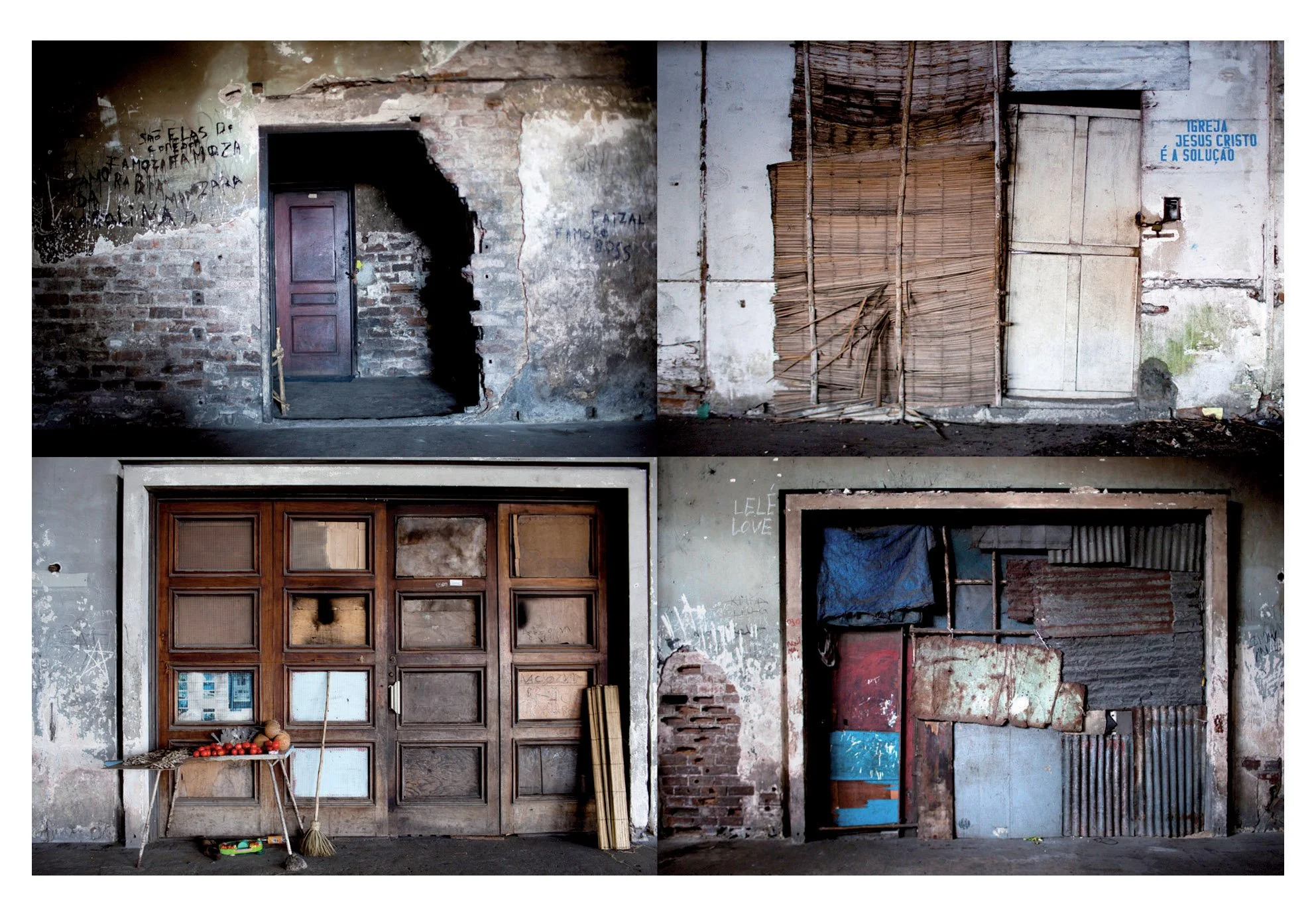
Grande Hotel -interview to Héctor Mediavilla-
The “Grande Hotel” was inaugurated in Beira (Mozambique) in 1955 with the ambition of becoming the most luxurious hotel in Africa. Over time, however, the ruins of a colonial dream became the precarious home of more than two thousand people. This project seeks to question colonial megalomania, the failed dreams of post-independence processes, and the fundamental human need for a home that we all share.
Interview with Héctor Mediavilla at the F. Català-Roca Photography Space
Héctor, social issues play a central role in your projects. In the case of “Grande Hotel”, how did the idea come about?
When I started working professionally as a photographer, I was mainly interested in social denunciation. Over time, my main motivation in visually documenting a story has become raising questions about identity and its contradictions, which emerge from specific social and historical contexts.“Grande Hotel” speaks about the past and the present, about colonial times and the independence of African countries. But above all, it speaks about people, their needs, and their dreams. I am interested in raising questions that help us reflect on the complexity of the contemporary world, which is shaped (or perhaps determined) by what we have done over decades or even centuries.The “Grande Hotel” project emerged in collaboration with the young local photographer Mario Macilau, funded by the Spanish Embassy in Mozambique. Together we developed a photographic and video project, which we later exhibited at the Núcleo de Arte in Maputo after our residency.There is an interesting aspect in your work that we would like to highlight: the originality in the choice of themes. You consistently explore little-known yet fascinating and sometimes mysterious subjects, such as S.A.P.E. With “Grande Hotel”, you once again address one of the less visible aspects of contemporary social and economic issues: the legacy of colonial processes in Africa and their impact on new generations.
How do you build the complexity of this subject in “Grande Hotel”?
I try to address issues that go beyond clichés, which are often the basis of our understanding of reality. Sometimes I also choose a well-known topic—such as the migratory phenomenon from Mexico to the U.S.—but approach it from a new perspective, for instance through the women who remain waiting for their husbands to return from the north (www.penelopesmexicanas.org). The reason is simple: if other documentary photographers have already addressed a subject well, I ask myself what I can contribute. A different aesthetic? I prefer to search for a new point of view or a subject that offers a broader understanding of reality.In the visual treatment of “Grande Hotel”, the structure of the building plays a central role. Except for a small series of portraits, I depict the hotel’s inhabitants almost like ghosts. The weight of the colonial past is immense. The Grande Hotel is an icon of that past—now in a terrible condition, yet still serving as a refuge for people arriving from the poorest provinces in northern Mozambique in search of a better future in Beira. At the beginning of the exhibition, I also show archival black-and-white images of the Grande Hotel in its former splendour.With my work, I do not aim to pass judgment, but rather to present reality in a way that encourages viewers to pause and reconsider their understanding of certain aspects of the contemporary world.On another level, this process of grandiose dreams embodied in unfinished monumental constructions may lead us to think that the problem is not as distant as it seems.
What do you think about the excessive construction boom in our country in recent years?
A disaster. It sounds easy to say now, but it was already evident at the time, when some claimed “Spain is doing well” and others shouted “You will never own a home in your life.” During the real estate bubble, Spain built more housing units than Germany, France, and Italy combined. Population growth in no way justified that construction frenzy.It is painful to see how we destroyed the coastline during the tourism boom under the dictatorship and realize that we learned nothing. Even worse is that now, in the midst of crisis, projects such as EuroVegas or Barcelona World emerge, which—under the justification of job creation—propose unsustainable models that make no sense beyond short-term economic exploitation of the territory. The crisis should serve to rethink our way of doing things and find new paths by learning from past mistakes. Unfortunately, this does not apply to our politicians, who are immersed in demagoguery and focus only on short-term interests and political survival.
In “Grande Hotel” you combine spatial aesthetics with the realities of the people who live there. What experiences did you have? What difficulties did you encounter?
I built strong relationships with some of the nearly 2,000 people living in the Grande Hotel: Bechani, Clara, Flora, Mr. Augusto… We talked, drank, and ate together. I gave them the photographs I took of them, which I developed in a terrible Chinese lab. You always encounter someone trying to sabotage your work, but overall I felt comfortable inside those impressive buildings.Most people living in the Grande Hotel would prefer to live somewhere safer, with water, electricity, and proper infrastructure.For me, the Grande Hotel felt like a return journey to my first long-term documentary project, which I completed ten years ago at the Sant Andreu Barracks. It was also an atypical space, marked by a strong sense of the past and inhabited by many people who had nowhere better to go. These are occupations born of necessity, not political stance.
These implicit photographic relationships between the space and the precarious “home” created within the hotel provide the necessary information for viewers to understand the project as a whole. Did you have a clear idea of the approach you wanted for your photographs?
Yes and no. On one hand, I wanted to emphasize the weight of such an imposing physical structure, and on the other, I wanted to give voice to the people who live there (see the multimedia piece with testimonies of the residents: http://vimeo.com/48125882). While photographing and filming, I allowed myself to be drawn by the spaces and by my interactions with the people living there. Abandoned buildings have something that fascinates me deeply.In general, I begin my projects with a conceptual framework—how I want to tell the story, what aesthetic approach is appropriate—but I like to let myself be guided by the sensations I experience once I am inside the story. Sometimes I start with one approach and end up changing it completely.
How long did the development of this project take? How was the process from the initial idea to the final conceptualization?
It is difficult to specify. We spent more than a month searching for stories with Mario Macilau before deciding that the Grande Hotel was a subject we were both interested in. We then spent four weeks photographing while also researching the hotel’s past, looking for documents, archival images, blueprints, and other materials. Due to the independence war, it was difficult to find historical records. Much of the history has been erased by the conflict, as in many other places.The collaboration culminated in an exhibition held in semi-ruined rooms at the Núcleo de Arte in Maputo, waiting to be restored. I designed the exhibition space using materials brought from the Grande Hotel, with very dim lighting and displays of period documents and blueprints. Even the bathroom—destroyed—contained photographs on its walls. It was the ideal space for an exhibition about such a fragile place.Finally, months later, after processing the experience, I created a 12-minute multimedia piece about the Grande Hotel.
From all the projects you have developed in different African countries, what would you highlight about the continent?
Above all, I would highlight the positive attitude towards life that most Africans have. In a way, they have been dealt “the ugliest dance partner,” yet instead of resigning themselves, they look forward while living the present to the fullest.I remember a question a young woman asked me years ago during a conversation about family: “If you want to have children, why don’t you have them now?” I replied that I was busy with other things, travelling a lot, etc., but that one day I would love to start a family. She answered: “Here in Africa, we do things differently. If you want something, you better do it today—you don’t know what will happen tomorrow. There could be a war, an illness, or an accident…”In Northern countries, we worry excessively about future security and forget to live moment by moment, here and now—which is the only reality we truly have.I have also learned a lot about the importance of community, of the extended family, of solidarity. They do not live in our bubble of exaggerated individualism.